Research

Bismuth–Metal Cooperativity for Selective C–C Bond Formation

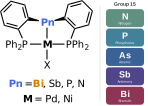
Transition metals are workhorse catalysts for building carbon–carbon bonds, and the supporting ligands bound to the metal largely dictate how a catalyst behaves. Our current platforms pair transition metals — including palladium and nickel — with bismuth as a supporting main-group ligand, and we ask a fundamental question: how does a heavy element like bismuth differ from the lighter, conventional donor ligands built on nitrogen, phosphorus, or antimony? By comparing reactivity, electronic structure, and catalytic performance across these ligand sets, and connecting molecular structure to reaction outcome through synthesis, spectroscopy, kinetics, and computation, we aim to turn bismuth–metal cooperativity into a general tool for selective carbon–carbon bond formation.
Light-Driven CO₂ Conversion with Molecules Containing Bismuth

Sunlight is abundant and free, yet using it to convert carbon dioxide into useful fuels and materials remains difficult: many artificial-photosynthesis systems rely on separate components — one to capture light, another to run the chemistry — that work inefficiently together and lose energy before it drives a reaction. In collaboration with the Sanders lab at Colgate, we ask whether integrating bismuth into a molecular framework can yield self-sensitized photocatalysts — single molecules that both absorb light and use that energy directly to transform CO₂, without the extra components that add cost and waste energy. This work aims to uncover design principles for self-sensitized photocatalysis while training students at the interface of inorganic chemistry, catalysis, and renewable energy.

Geometrically Constrained Molecular Bismuth Complexes

Like all pnictogens — nitrogen, phosphorus, and their heavier congeners — bismuth is intrinsically trigonal pyramidal, its three bonds splayed around a stereochemically active lone pair. This default geometry sets pnictogens apart from transition metals, whose flexible coordination environments underlie their rich catalytic reactivity. We ask a provocative question: can we "tame" bismuth — the heaviest non-toxic, stable main-group element — so that it behaves more like a transition metal, simply by controlling its geometry? Molecular bismuth is appealing precisely because it is low-cost, low-toxicity, and electronically distinctive, yet well-defined complexes that break from its natural pyramidal shape remain relatively underexplored. By developing synthetic routes that deliberately constrain the geometry around bismuth, we aim to unlock reactivity and electronic properties inaccessible to conventional arrangements — expanding the toolbox of main-group bismuth chemistry and revealing how structure governs reactivity, with an eye toward new catalysts and functional molecules.